
What Is Long-Form Content? A 2026 Guide for Marketers
What Is Long-Form Content? A 2026 Guide for Marketers
Long-form content is any digital media that covers a topic with enough depth and length to fully satisfy what a reader, viewer, or listener came to learn. For written content, that threshold sits at 1,000 words or more, with many practitioners using 1,200 to 1,500 words as the practical baseline. For video, the standard is 10 minutes or longer, with the strongest YouTube creators favoring 15 to 60 minutes. For podcasts, episodes under 20 minutes rarely qualify. Whether you are a content creator, marketer, or business owner in Tyler, Texas or anywhere else, understanding this format is one of the highest-leverage moves you can make for your online visibility in 2026.
What is long-form content, and how is it defined?
Long-form content is defined as digital media that provides comprehensive, in-depth coverage of a topic beyond what short-form content delivers. The industry term you will see in SEO and content marketing circles is “long-form content,” and it applies across written articles, video, audio, and downloadable assets. The key distinction is not just length. It is whether the content fully addresses the questions and intent of the audience consuming it.

Word count alone is a flawed measuring stick. Content depth correlates far more strongly with search ranking than raw word count does. A 2,500-word article stuffed with repetition ranks worse than a focused 1,400-word piece that answers every relevant question a reader has. This means long-form content is better understood as an intent-delivery asset than a length target.
| Characteristic | Long-form content | Short-form content |
|---|---|---|
| Written length | 1,000+ words (often 1,200–2,500+) | Under 1,000 words |
| Video length | 10+ minutes (typically 15–60 min) | Under 10 minutes |
| Audio length | 20+ minutes | Under 20 minutes |
| Primary goal | Depth, authority, SEO, lead generation | Awareness, quick engagement |
| Best platforms | Google, YouTube, LinkedIn, email | Instagram, TikTok, X, Facebook |
| Typical formats | Guides, white papers, webinars, podcasts | Reels, tweets, short blogs, stories |
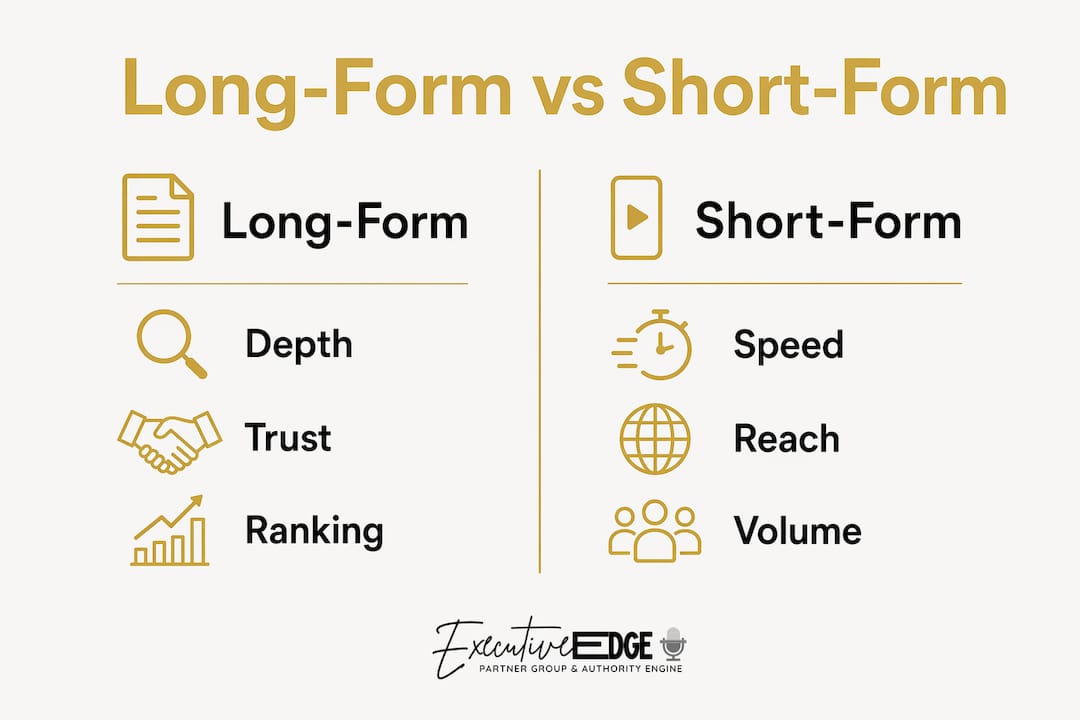
Short-form content wins for speed and reach. Long-form content wins for trust, ranking, and conversion. The best content strategies use both, but they serve different jobs.
Pro Tip: Before you write a single word, ask what specific question your audience is trying to answer. If the answer requires more than one or two paragraphs to cover completely, you are likely looking at a long-form opportunity.
Why long-form content outperforms for SEO and engagement
The SEO case for long-form content is grounded in how search engines evaluate usefulness. Comprehensive content satisfies informational intent, which signals to Google that a page deserves to rank. When a single article answers multiple related questions, it captures more keyword variations, earns more time on page, and generates more return visits. Each of those signals feeds the ranking algorithm.
Backlinks are the other major benefit. Well-crafted long-form pieces earn stronger backlinks and higher share rates than short content because they function as reference resources. When a journalist, blogger, or researcher needs to cite a source, they link to the most complete explanation they can find. A 300-word post rarely qualifies. A definitive 2,000-word guide often does.
Here is what long-form content consistently delivers when done well:
- Higher search rankings because comprehensive coverage addresses more search queries within a single piece
- More backlinks because detailed, well-researched content becomes a reference others cite
- Longer time on page because readers stay to absorb complete information rather than bouncing to find the rest of the answer elsewhere
- Greater topical authority because publishing multiple in-depth pieces on related subjects signals expertise to both readers and search engines
- Better lead quality because readers who consume 1,500 words of your content are far more qualified than someone who skimmed a caption
The cost consideration is real. Quality writers may charge around $0.50 per word at the lower end of the market, and a thorough 2,000-word article requires research, editing, and formatting time on top of that. The return, however, compounds over time. A well-optimized long-form article can generate organic traffic for years without additional spend.
Pro Tip: Pair your long-form content with a strong internal linking structure. Each new in-depth article should link to two or three related pieces on your site. This distributes authority and keeps readers moving through your content ecosystem.
Long-form content examples across formats
Long-form content spans multiple media types, and understanding the full range helps you choose the right format for your audience and goals. The written blog post is the most common entry point, but it is far from the only option.
| Format | Typical length | Primary use |
|---|---|---|
| Blog post or article | 1,200–3,000+ words | SEO, thought leadership, education |
| Ultimate guide | 3,000–10,000+ words | Authority building, lead generation |
| White paper | 2,500–6,000 words | B2B lead generation, credibility |
| Ebook | 5,000–20,000+ words | Lead magnet, product education |
| YouTube video | 15–60 minutes | Engagement, search visibility |
| Podcast episode | 20–90 minutes | Audience loyalty, brand authority |
| Webinar | 30–90 minutes | Lead generation, direct sales |
| Case study | 1,000–3,000 words | Trust building, conversion |
| Detailed interview | 2,000–5,000 words | Authority, audience engagement |
The video category deserves specific attention. Long-form YouTube content justifies viewer time through sustained value, not arbitrary duration. A 20-minute tutorial that teaches a complete skill outperforms a 45-minute video that meanders. The same principle applies to podcasts. Episodes in the 20 to 60-minute range that stay tightly focused on a single topic consistently outperform longer episodes that drift.
For content marketing in the beauty industry, for example, long-form video and written content have become primary drivers of brand authority and organic discovery. The same pattern holds across service industries, professional services, and local businesses.
How to create long-form content that actually works
Effective long-form content starts with audience intent, not a word count target. Planning centered on user needs produces content that earns links and ranks better than content built around hitting a number. Before you outline a single section, list every question your audience has about the topic. That list becomes your structure.
Follow this process to build long-form content that performs:
- Research your audience’s questions first. Use tools like Google’s “People Also Ask” boxes, Reddit threads, and Quora to find the exact language your audience uses. These questions become your headings.
- Outline before you write. A clear structure with H2 and H3 headings prevents the content from becoming a wall of text. Structured formatting prevents information overload and keeps readers moving through the piece.
- Write the introduction last. Once you know what the full article covers, you can write an opening that accurately previews the value and hooks the reader immediately.
- Integrate multimedia. Images, charts, embedded videos, and data tables break up text and give visual learners an entry point. They also increase time on page.
- Edit for clarity, not length. Tools like Grammarly and Hemingway Editor help you cut passive voice, reduce sentence complexity, and flag readability issues. The goal is the clearest possible version of your argument, not the longest.
- Add a strong call to action. Every long-form piece should tell the reader what to do next, whether that is downloading a resource, booking a call, or reading a related article.
Pro Tip: Repurpose every long-form piece into at least three shorter formats. A 2,000-word blog post becomes a LinkedIn article, a short video script, and five social media posts. This multiplies your reach without multiplying your production time.
Why I think most businesses underestimate long-form content
The businesses I see struggling most with online visibility share a common pattern. They publish frequently but shallowly. They chase posting schedules instead of building resources. And then they wonder why their traffic plateaus after a few months.
Long-form content is not a volume game. It is a depth game. One genuinely useful 2,000-word guide that answers every question a prospective client has will outperform twelve 400-word posts that each answer one question partially. I have watched this play out consistently with businesses across East Texas and beyond. The ones who commit to depth, even when it takes longer, build compounding authority that short-form content simply cannot replicate.
The challenge I hear most often is time. Writing 2,000 words feels like a significant commitment when you are also running a business. The solution is not to lower the bar. It is to build a system. Record yourself answering client questions on video, transcribe it, and use that as the foundation for a written piece. Interview a team member or partner and turn that conversation into a case study. The raw material for long-form content already exists in most businesses. It just needs to be captured and shaped.
The other mistake I see is treating long-form content as a one-time effort. A well-optimized article needs to be updated as information changes, internal links need to be added as new content is published, and performance data should inform what gets expanded or refreshed. Long-form content is a living asset, not a published-and-forgotten document.
— David Domm
Build your authority with long-form content strategy
If you are ready to stop publishing content that disappears and start building assets that compound over time, Executive Edge Partner Group is built for exactly that.

Executive Edge Partner Group helps business owners, consultants, and local brands turn their expertise into strategic long-form content optimized for Google, YouTube, and AI-driven search platforms. From blog articles and podcast episodes to video scripts and authority campaigns, the system does the heavy lifting so you can focus on running your business. Visit Executive Edge Partner Group to learn how a done-for-you content strategy can build your visibility and trust online without requiring you to become a full-time content creator.
FAQ
What is the minimum length for long-form content?
For written content, the standard baseline is 1,000 words, with many SEO practitioners using 1,200 words as the practical minimum. For video, the threshold is 10 minutes, and for podcasts, 20 minutes.
Does longer content always rank better on Google?
No. Depth and comprehensive coverage drive rankings far more than word count alone. Filler content that inflates length without adding value can actually weaken SEO performance.
What are the best formats for long-form content?
Common formats include blog posts over 1,200 words, ultimate guides, white papers, ebooks, YouTube videos over 10 minutes, podcast episodes over 20 minutes, webinars, and detailed case studies. Each format serves a different audience goal and distribution channel.
How do I repurpose long-form content effectively?
Break each long-form piece into shorter assets: pull key sections for LinkedIn posts, convert main points into a short video script, and use statistics or quotes as standalone social media content. A content strategy built around repurposing multiplies reach without proportionally increasing production effort.
Why should business owners invest in long-form content?
Long-form content builds topical authority, earns backlinks, and generates organic traffic that compounds over time. Unlike paid advertising, a well-optimized long-form article continues to attract qualified visitors months or years after publication.