
Why Contractors Need Online Content to Win Clients
Online content is the primary mechanism through which contractors attract qualified leads, establish credibility, and compete in a market where most clients begin their search on Google or an AI platform before ever picking up a phone. The industry term for this practice is content marketing, and for contractors, it is no longer optional. In 2026, AI-powered local recommendations surged from 6% to 45% of consumers, meaning nearly half your potential clients are now asking ChatGPT or Perplexity who to hire before they visit your website. For contractors in Tyler, Texas and across East Texas, that shift is already reshaping how jobs are won and lost.
Why contractors need online content to get found first
The most direct benefit of online content for contractors is search visibility. When a homeowner types “roof replacement near me” or “licensed electrician in my area,” Google and AI platforms scan the web for the most authoritative, relevant content available. Contractors without consistent content online simply do not appear. Those with it do.

SEO and local keyword targeting are the foundation of that visibility. A contractor who publishes blog posts answering common client questions, maintains an accurate Google Business Profile, and uses location-specific keywords in their content will consistently outrank competitors who rely only on word of mouth. This is not theory. It is how search algorithms are designed to work.
Here is what a practical content visibility strategy looks like for a contractor:
Blog posts targeting questions like “how much does a bathroom remodel cost” or “what to look for in a licensed HVAC contractor”
Project showcases with before-and-after photos and brief written descriptions of the work completed
Video walkthroughs of finished jobs posted to YouTube and embedded on your website
Consistent business listings on Google, Yelp, Houzz, and Angi with identical name, address, and phone number across every platform
Location-specific service pages that name the cities and counties you serve
Pro Tip: Create one piece of content per week focused on a specific service or project type. Over 12 months, that becomes 52 indexed pages working for you around the clock.
The consistent business info across platforms matters more than most contractors realize. AI recommendation engines pull data from multiple sources simultaneously. If your phone number on Yelp differs from your Google listing, AI tools flag the inconsistency and reduce your authority score. Accuracy is a ranking signal.
How reviews and authoritative content build client trust
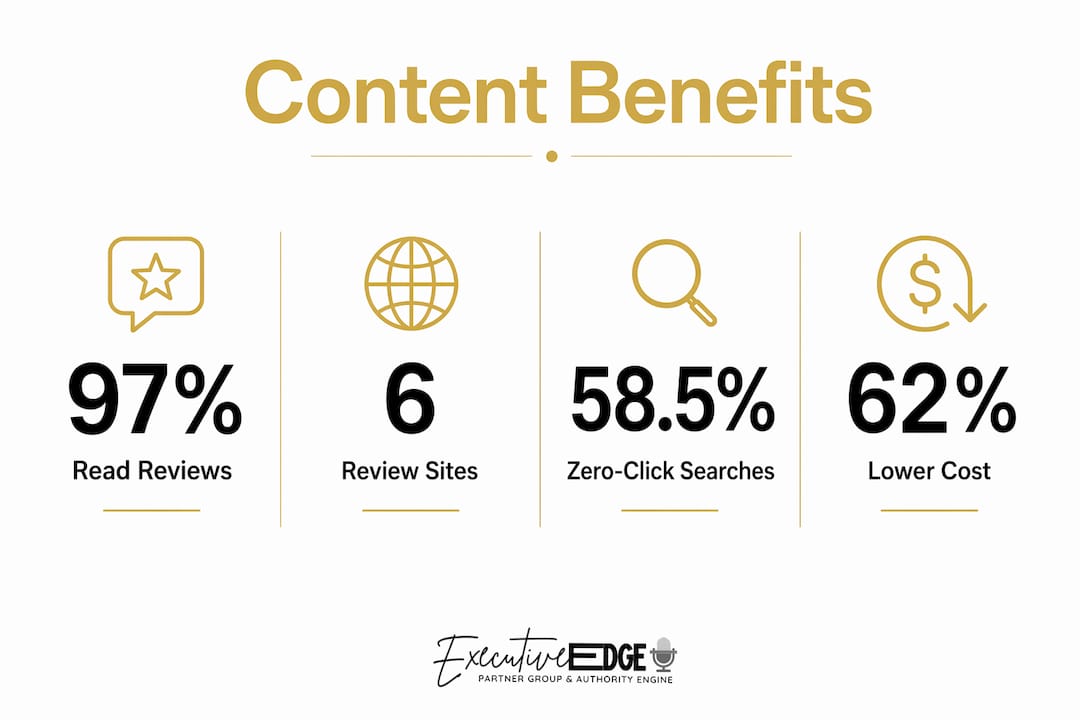
97% of consumers read online reviews before choosing a local business. That number is not a trend. It is the baseline expectation your clients bring to every search. And in 2026, 41% of consumers always read reviews before making a decision, up from 29% just one year prior. The implication is clear: your online reputation is your first impression, not your handshake.
Reviews alone are not enough. Clients cross-reference reviews with the content they find on your website, your social profiles, and your project portfolio. A contractor with 50 five-star reviews and a bare-bones website loses credibility compared to a competitor with 30 reviews and a detailed site showing real project outcomes, client testimonials, and clear service descriptions.
Here is a repeatable system for building trust through content and reviews:
Ask for specific reviews. After completing a job, ask clients to mention the specific service, location, and outcome in their review. “They replaced our roof in three days and left the yard spotless” is far more persuasive than “Great work!”
Respond to every review. Responding to reviews signals professionalism and shows prospective clients that you are engaged. Google also factors response activity into local rankings.
Repurpose reviews into content. Pull strong testimonials into your website’s project pages, social media posts, and email follow-ups. One good review can generate five pieces of content.
Build FAQ pages from real client questions. If three clients asked you the same question before signing a contract, that question belongs on your website. It answers the concern for future prospects before they even call.
Publish case studies. A 300-word write-up of a completed project, including the problem, your solution, and the result, builds authority that no advertisement can replicate.
Consumers use an average of six review sites when evaluating a business. That means your reputation management cannot stop at Google. Yelp, Facebook, Houzz, and industry-specific directories all contribute to the picture a prospective client assembles before contacting you.
Pro Tip: Set a calendar reminder every Friday to respond to any new reviews from that week. Consistency in review management compounds over time and directly affects your local search ranking.
What zero-click searches mean for contractor visibility
58.5% of Google searches end without a single click to an external website. That statistic reframes the entire goal of online content. If more than half of all searches never result in a website visit, contractors cannot measure success by website traffic alone. The goal shifts to brand presence, meaning your business name, services, and reputation appear in the search result itself, not just behind a link.
This is where structured content becomes critical. Google pulls information for featured snippets, knowledge panels, and AI-generated summaries directly from well-organized, clearly written content. Contractors who write concise answers to common questions, use proper heading structures, and maintain accurate business profiles are the ones who appear in those zero-click results.
The table below compares two content approaches and their impact on zero-click visibility:
Content approachZero-click visibilityBrand authority signalClient trust impactNo structured content, referral-onlyNoneWeakLowBlog posts with FAQ sectionsModerate (featured snippets)GrowingMediumFull content strategy with structured dataHigh (knowledge panels, AI summaries)StrongHighMulti-platform presence with consistent infoMaximum (AI recommendations + SERP features)DominantVery high
AI summaries surface review insights but often strip out the nuance that makes a contractor stand out. A client asking an AI assistant “who is the best roofer in my area” gets a synthesized answer. The contractors who appear in that answer are the ones with the most consistent, detailed, and well-distributed content across the web. Optimizing for that outcome is now a core part of any content strategy for construction businesses.
Content marketing vs. traditional outbound marketing for contractors
Most contractors built their businesses on referrals, door-to-door canvassing, yard signs, and direct mail. Those methods still have value, but they share a critical weakness: they stop working the moment you stop paying for them or asking for them. Content marketing works differently.
Content marketing generates three times as many leads as outbound methods at 62% lower cost. For a contractor running on tight margins, that math matters. A blog post written today can generate inquiries for the next three years. A direct mail campaign generates inquiries for three weeks, then costs money again to repeat.
The practical advantages of content marketing for contractors include:
Compounding returns. Every piece of content you publish adds to a permanent library that works continuously without additional spend.
Pre-qualified leads. A client who found you by reading your article on “what to expect during a kitchen remodel” already understands your process and is further along in their decision.
Referral amplification. When a referral client searches your name online and finds a professional website with detailed project photos and strong reviews, the referral converts at a higher rate.
Reduced price sensitivity. Clients who have consumed your content before calling perceive you as an authority. They are less likely to negotiate aggressively on price.
The strongest contractor marketing strategy combines both approaches. Referrals bring warm leads. Content marketing brings cold leads who become warm through education. Neither replaces the other, but content marketing scales in ways that outbound never can.
What I’ve learned watching contractors ignore their digital presence
I have worked with enough service-based businesses to say this plainly: the contractors who resist building an online presence are not protecting their time. They are handing clients to competitors who figured this out two years ago.
The pattern is consistent. A contractor with 20 years of experience and an excellent reputation loses a bid to a newer competitor with half the skill but a polished website, 80 Google reviews, and a YouTube channel showing their work. The experienced contractor cannot understand why. The answer is always the same: the client could not find enough information to trust them before the call.
What I advise contractors to do is start with the smallest possible version of a content system and build from there. One project photo per week. One Google review request per completed job. One FAQ answer per month. Over a year, that becomes a credible digital presence that AI tools, Google, and prospective clients can all evaluate favorably. The strategies for building trust online are not complicated. They require consistency more than creativity.
The contractors I see winning in competitive markets, including right here in East Texas, are not necessarily the best at their trade. They are the best at making their expertise visible. That is a solvable problem, and it starts with content.
— David Domm
How Executive Edge Partner Group helps contractors build authority online

Executive Edge Partner Group works specifically with contractors and service-based businesses who want to stop losing bids to less-qualified competitors with better online visibility. The done-for-you Authority Engine system handles content creation, SEO, review management strategy, and multi-platform publishing so you can focus on the work you are actually good at. You do not need to become a content creator. You need a system that turns your expertise into discoverable, trust-building content. Visit Executive Edge Partner Group to see how contractors are using content marketing to grow their client base and protect their reputation in competitive local markets.
FAQ
Why do contractors need online content in 2026?
Online content is how contractors get found by clients using Google, AI tools, and review platforms. With AI recommendations rising to 45% of local business searches, contractors without content are invisible to nearly half their potential clients.
How many reviews does a contractor actually need?
There is no fixed number, but consumers check an average of six review sites before deciding. Consistent reviews across Google, Yelp, and industry directories matter more than volume on a single platform.
What type of content works best for contractors?
Project showcases with before-and-after photos, FAQ pages answering common client questions, and short video walkthroughs consistently perform well. These formats support both SEO keyword targeting and client trust-building simultaneously.
Does content marketing really cost less than traditional advertising?
Content marketing generates three times more leads at 62% lower cost than outbound methods. The cost advantage compounds over time because published content continues generating leads without additional spend.
What is a zero-click search and why does it matter for contractors?
A zero-click search ends on the Google results page without the user clicking any link. Since 58.5% of searches end this way, contractors need content optimized for featured snippets and AI summaries, not just website traffic.